
Services

Individual therapy is one-on-one support to build the life that you want for yourself. You and you therapist can discuss the type of therapy and support you feel best supports you.
Individual Therapy

Groups can provide a sense of community. If you’re interested in participating in a group of your peers, please reach out, and we will keep you updated with upcoming groups!
Group Therapy

For you and your important relationships, whether you are wanting to work on romantic partnerships, family dynamics, co-parenting strategies, QPRs, or work with any other of your VIPs, this is for you.
Relational Therapy

Making sense of things right now as an adult is hard, and it’s even harder for our younger folks. Adolescents and children can absolutely benefit from participation in therapy services. Early support has been shown to lay a foundation that youth can use as they grow into themselves in adulthood.
For Youth

Looking for clinical supervision? Miranda supervises new therapists working toward a license in marriage and family therapy. Her style is informed by Relational-Cultural Theory and systemic practice to navigate the different relationships and experiences that occur for clients, supervisees, and the supervisor. Miranda offers a free 30 minute consultation to determine fit for supervision and to discuss options. Please reach out for more information!
MFT Supervision

Dialectical Behavioral Therapy (DBT) can show up in different ways in therapy. There is DBT-informed treatment that applies many of the DBT skills, but does not adhere to the full structure of evidence-based DBT programs. All therapy with Miranda is DBT-informed due to her training. However, there is a more intensive version of DBT called Comprehensive DBT for those that need more advanced support. Read more in the next section below.
Dialectical Behavioral Therapy


What is Comprehensive DBT?
DBT was originally created by Dr. Marsha Linehan to address the shortcomings of mental health care that she herself experienced as a patient. In her memoir, Building a Life Worth Living, she chronicled her own experiences with inpatient care, the extremes of emotional distress, and a profound lack of helpful options. DBT was designed to provide a different kind of support for those with chronic and intense suicidal thoughts and symptoms of what has come to be known as Borderline Personality Disorder. Since the original creation of this model, DBT has expanded to be considered a top-tier evidence-based treatment for intense emotions, mood and anxiety concerns, difficulties in relationships with others, addition, and many other concerns. This emphasis on self-acceptance and self-regulation is supported in Comprehensive DBT in four main ways.
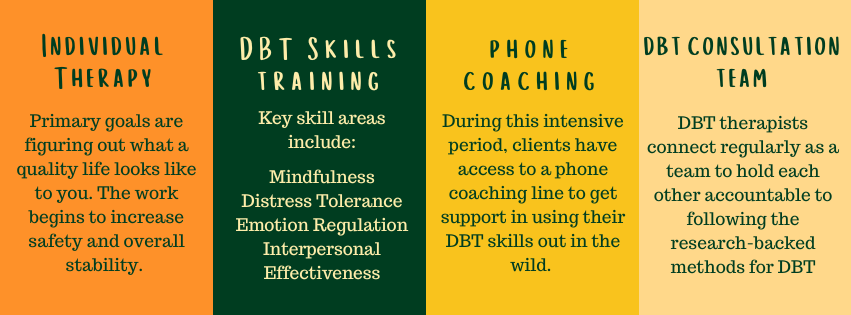
Folks interested in participating in Comprehensive DBT can expect to collaborate with Miranda for 3-5 sessions of what DBT calls ‘pre-treatment’ where you’ll work together to determine your goals and targets for treatment prior to making a commitment to move forward with Comprehensive DBT. You can read more in Miranda’s articles Dialectical Behavioral Therapy and Is DBT Right for Me? originally published with Kalamazoo Therapy Group.
DBT is considered an evidence-based treatment when it’s upheld as designed. That being said - there is room within DBT structure to make it your own. Original manualized DBT did not include explicit information related to cultural nuance and varied experiences. Miranda’s goal is to make your therapy specific to you, based on your own identities and experiences. The goal of DBT is not for you to be able to ‘control’ yourself to meet someone else’s standards, but instead is about you creating a quality of life that matters to you. That centers context. Your story is at the heart of this process.
You can always ask questions about Comprehensive DBT. Sometimes Miranda and her clients decide that Comprehensive DBT is not the best fit - and that’s okay! Miranda is committed to making sure that your therapy benefits you. If you come in asking about Comprehensive DBT, there will be LOTS of opportunities to ask questions.
Comprehensive DBT can be extremely rewarding and many who have tried other types of therapy describe it as a ‘breath of fresh air’ to be so active and action-oriented. DBT provides the overall structure to build the life that you want, or as Marsha calls it, a life worth living.
For younger folks seeking treatment, it’s important to note that Comprehensive DBT also typically includes an element of relational therapy, where caregivers participate in additional therapy sessions. The overarching goal of this is to create a change ready environment. This can center around specific parent skills training, reducing risk in home environments, and building more validating interactions within their family. When appropriate, this can also be broadened into family therapy that includes youth and/or other family members.
Miranda trained with folks that were trained by Marsha Linehan herself when she was developing and publishing DBT protocols. She continues to participate in a DBT consultation team with 5-7 other DBT therapists with extensive training. These therapists practice throughout the United States, and all share the same values for inclusive and affirming care. Miranda has prior experiences as the individual and relational therapists for both adolescents and adults participating in outpatient Comprehensive DBT programs as well as DBT Intensive Outpatient Programs (DBT IOP). She also taught several different adolescent/family/adult DBT skills training courses.
Her formal DBT training also includes DBT for Children (DBT-C) and DBT Superparenting Courses I & II with Dr. Francheska Perepletchikova, Using DBT with Autistic Individuals with Dr. Lorie Ritschel, and Advanced Case Conceptualization and DBT Foundational Training with Dr. Shari Manning.
Also, Miranda knows that if you’re even considering Comprehensive DBT, then this is not your first stop or your first attempt to find the right fit to get what you want out of therapy. While DBT itself does not solve all the world’s problems, Miranda does believe that folks who lean in with DBT find a sense of empowerment and self-acceptance.